
A couple of years ago my wife and I went to Oaxaca. We had the great pleasure of visiting Monte Alban, a Zapotec mountain site and former capital of the Zapotec people. We stood among their ancient pyramids and temples overlooking the Oaxaca Valley. I saw the carved stones, the plazas, the quiet dignity of Indigenous communities who still carry their traditions in their bones. But I never made the connection between that world and our Monkey.
For years I have tried to understand Monkey’s silence. His way of moving through the world without words. We have searched for explanations in medicine, therapy, behavior charts, and developmental timelines. But none of those frameworks ever felt big enough for him. None of them honored the mystery of who he is.
As I’ve continued to understand the modern diagnosis and treatment of autism, I’ve never looked to make connections with our roots in Mexico. Connections to something older, indigenous and that belongs to the lands of our ancestors.
Then I ran into some reading material about the Zapotec concept of the “tona”.
In Zapotec cosmology, every child is born with a spirit companion. The tona is not a symbol or a metaphor. It is a living force tied to the day of birth, a second soul that shapes perception, sensitivity, and even destiny. Some tona spirits, some are fierce, others are playful but some are deeply connected to the moon, the wind, or the night.
Zapotec elders believed that children with strong tona spirits often behaved in ways that stood out. These children spoke late or not at all. They reacted intensely to light, wind, or sound. They laughed suddenly. They woke up under the moon. They moved with unpredictable rhythms, we call it stimming. They sensed things adults could not.
These children were not seen as delayed. They were seen as “spirit touched”.
A child who did not speak was not nonverbal. His communication was with his tona.
A child who woke under the moon was not restless. He was responding to lunar energy, which the Zapotec understood as a living force.
A child who laughed at shadows was not in his own world. He was interacting with the spirit world, which overlaps with ours.
Silence was not a deficit. It was a spiritual language.
When I read this, something inside me shook. I thought of his joy, his pacing, his sudden bursts of energy, his quiet moments of deep focus. I thought of all the times I wondered what he was seeing, what he was feeling, what he was trying to tell me without words.
And the truth is he has always been speaking.
Maybe Monkey’s tona is wide awake. Maybe his spirit companion is louder than his human voice. Maybe his silence is not emptiness but a connection we have not learned to hear.
He fits into a story that is older than diagnosis. Older than charts. Older than the language we use today.
And here is the part that stays with me. When I stood at Monte Alban, I thought I was looking at the past. But now I understand I was standing in a place that still speaks. A place that holds the memory of children like Monkey. A place where his way of being would not be questioned, but recognized.
Autism did not begin with modern medicine. Our ancestors had a place for children who sensed the world differently. They had a language for it. They had a cosmology for it.
They had a way to honor it.
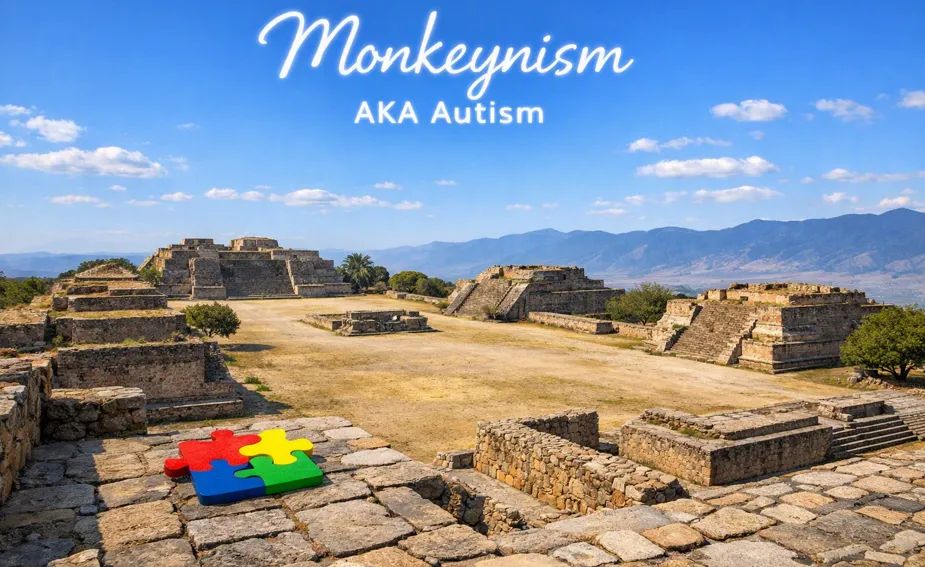
 Monkeynism AKA Autism